
 RETURN TO SEARCH RESULTS
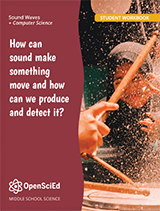
OpenSciEd Unit 8.2 + Computer Science: How can a sound make something move? Student Workbook
Author(s): NATIONAL CENTER FOR CIVIC INNOVATION (OPENSCIED)
Edition: 1
Copyright: 2025
Pages: 120
CHOOSE FORMAT
OpenSciEd Middle School science program addresses all middle school NGSS standards. This comprehensive science curriculum empowers students to question, design, investigate, and solve the world around them.
- Phenomenon Based - Centered around exploring phenomena or solving problems
- Driven by Student Questions - Storyline based on students’ questions and ideas
- Grounded in Evidence - Incremental building and revision of ideas based on evidence
- Collaborative - class and teacher figure out ideas together
- Equitable - Builds a classroom culture that values ideas and learning of all
The OpenSciEd computer science units use a flexible “STEM sound board” approach that turns science, technology, engineering, math, and computer science up or down to match each lesson’s goals. Students experience just the right mix of STEM as they explore a storyline, discovering how science and computer science naturally work together. From modeling and analyzing data to designing creative solutions inspired by real-world phenomena, learners see how these fields team up to solve meaningful problems.
Unit 8.2 + Computer Science: How can sound make something move and how can we produce and detect it?
This unit on sound begins with students observing an interesting phenomenon: a truck is playing loud music in a parking lot, and the windows of a building across the parking lot visibly shake in response to the music. They try to explain what is happening at the truck speaker (sound source), the window (sound receiver) and in the space between. Students consider other sound-related phenomena. These activities spark a series of questions and ideas for investigations around the question, How can sound make something move, and how can we produce and detect it? This drives the work for the unit, with the first third of the unit focusing on figuring out how sound is produced, how it travels, and how it makes something move. The second third of the unit focuses on figuring out how different sounds are made by gathering and analyzing data collected using micro:bits and modify MakeCode programs to produce different sounds with a micro:bit. The last third of the unit focuses on figuring out how living things detect and respond to sounds with an opportunity to learn about how sound-based sensor systems help to monitor and protect animals.
Perfectly aligned with each unit, the consumable student workbook provides students with a dedicated space to write through their ideas and thoughts with every exercise and activity helping to reinforce important themes and concepts.
The Student Edition, Teacher Edition and material kits are sold separately.

NATIONAL CENTER FOR CIVIC INNOVATION (OPENSCIED)
OpenSciEd® was launched to improve the supply of and address the demand for high-quality, open-source, full course science instructional materials. The goals of OpenSciEd are to ensure any science teacher, anywhere, can access and download freely available, high quality, locally adaptable materials. OpenSciEd classroom materials are an open education resource and therefore free to download, copy, use, and/or modify. You can download the instructional materials free of charge at Access Materials page on the OpenSciEd website. In an effort to lower barriers for all educators to use OpenSciEd, Kendall Hunt and OpenSciEd have partnered to sell high quality printed books, professional learning and lab kits.