
 RETURN TO SEARCH RESULTS
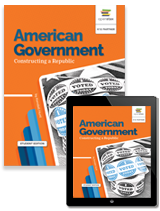
OpenStax K-12: American Government Student Edition + 1 Year License
Author(s): OpenStax
Edition: 1
Copyright: 2026
Pages: 896
CHOOSE FORMAT
Kendall Hunt is proud to partner with OpenStax, the world’s largest nonprofit publisher and an initiative of Rice University, to deliver high-quality, affordable instructional resources for schools nationwide. Combining OpenStax’s trusted, research-based content with Kendall Hunt’s expertise in curriculum development, customization, and distribution, this partnership provides educators with flexible, standards-aligned learning solutions that engage students and support meaningful outcomes. The collaboration reflects a shared commitment to educational equity, innovation, and expanding access to exceptional learning experiences for all students.
American Government guides students from the foundational principles of the nation’s founding through political participation and the structures that shape American government today. Through historical examples, current events, primary sources, and perspectives from diverse communities, students gain a deeper understanding of how government impacts everyday life. The program’s balanced and comprehensive approach helps students not only understand key concepts, but also apply them as informed learners, future professionals, and engaged citizens.
Included in this purchase is a perfect bound, Student Edition print book and 1 year access to the Student Edition eBook and digital resources through our online platform, Flourish.
Chapter 1 American Government and Civic Engagement
- 1.1 What Is Government?
- 1.2 Who Governs? Elitism, Pluralism, and Tradeoffs
- 1.3 Engagement in a Democracy
Chapter 2 The Constitution and Its Origins
- 2.1 The Pre-Revolutionary Period and the Roots of the American
- Political Tradition
- 2.2 The Articles of Confederation
- 2.3 The Development of the Constitution
- 2.4 The Ratification of the Constitution
- 2.5 Constitutional Change
Chapter 3 American Federalism
- 3.1 The Division of Powers
- 3.2 The Evolution of American Federalism
- 3.3 Intergovernmental Relationships
- 3.4 Competitive Federalism Today
- 3.5 Advantages and Disadvantages of Federalism
Chapter 4 Civil Liberties
- 4.1 What Are Civil Liberties?
- 4.2 Securing Basic Freedoms
- 4.3 The Rights of Suspects
- 4.4 Interpreting the Bill of Rights
Chapter 5 Civil Rights
- 5.1 What Are Civil Rights and How Do We Identify Them?
- 5.2 The African American Struggle for Equality
- 5.3 The Fight for Women’s Rights
- 5.4 Civil Rights for Indigenous Groups: Native Americans, Alaskans, and Hawaiians
- 5.5 Equal Protection for Other Groups
Chapter 6 The Politics of Public Opinion
- 6.1 The Nature of Public Opinion
- 6.2 How Is Public Opinion Measured?
- 6.3 What Does the Public Think?
- 6.4 The Effects of Public Opinion
Chapter 7 Voting and Elections
- 7.1 Voter Registration
- 7.2 Voter Turnout
- 7.3 Elections
- 7.4 Campaigns and Voting
- 7.5 Direct Democracy
Chapter 8 The Media 371
- 8.1 What Is the Media?
- 8.2 The Evolution of the Media
- 8.3 Regulating the Media
- 8.4 The Impact of the Media
Chapter 9 Political Parties
- 9.1 What Are Parties and How Did They Form?
- 9.2 The Two-Party System
- 9.3 The Shape of Modern Political Parties
- 9.4 Divided Government and Partisan Polarization
Chapter 10 Interest Groups and Lobbying
- 10.1 Interest Groups Defined
- 10.2 Collective Action and Interest Group Formation
- 10.3 Interest Groups as Political Participation
- 10.4 Pathways of Interest Group Influence
- 10.5 Free Speech and the Regulation of Interest Groups
Chapter 11 Congress
- 11.1 The Institutional Design of Congress
- 11.2 Congressional Elections
- 11.3 Congressional Representation
- 11.4 House and Senate Organizations
- 11.5 The Legislative Process
Chapter 12 The Presidency
- 12.1 The Design and Evolution of the Presidency
- 12.2 The Presidential Election Process
- 12.3 Organizing to Govern
- 12.4 The Public Presidency
- 12.5 Presidential Governance: Direct Presidential Action
Chapter 13 The Courts
- 13.1 Guardians of the Constitution and Individual Rights
- 13.2 The Dual Court System
- 13.3 The Federal Court System
- 13.4 The Supreme Court
- 13.5 Judicial Decision-Making and Implementation by the Supreme Court
Chapter 14 State and Local Government
- 14.1 State Power and Delegation
- 14.2 State Political Culture
- 14.3 Governors and State Legislatures
- 14.4 State Legislative Term Limits
- 14.5 County and City Government
Chapter 15 The Bureaucracy
- 15.1 Bureaucracy and the Evolution of Public Administration
- 15.2 Toward a Merit-Based Civil Service
- 15.3 Understanding Bureaucracies and Their Types
- 15.4 Controlling the Bureaucracy
Chapter 16 Domestic Policy
- 16.1 What Is Public Policy?
- 16.2 Categorizing Public Policy
- 16.3 Policy Arenas
- 16.4 Policymakers
- 16.5 Budgeting and Tax Policy
Chapter 17 Foreign Policy
- 17.1 Defining Foreign Policy
- 17.2 Foreign Policy Instruments
- 17.3 Institutional Relations in Foreign Policy
- 17.4 Approaches to Foreign Policy
Glossary
Index
Images
OpenStax
OpenStax is a nonprofit based at Rice University, committed to improving student learning and access to education. Our openly licensed textbooks are written and peer-reviewed by subject matter experts and meet the scope and sequence requirements of their respective college courses. Unlike traditional textbooks, OpenStax books are available for free and are always up to date online. Each book comes with optional low-cost resources from our partners as well as completely free instructor and student ancillaries. With the support of our philanthropic partners, OpenStax is empowering students and instructors by breaking down the most common barriers to learning.