
Search Listing Name
product:
Project M3: Level 4-5: Treasures from the Attic: Exploring Fractions Teacher 3 Year License
This unit provides an introduction to fractions, focusing on the meaning of mathematical operations in contextual situations rather than learning algorithms to perform computations. Students will learn the relative sizes of fractions and make estimates based on their mathematical thinking when ordering, comparing, adding, subtracting, multiplying or dividing two or more fractions.
The Teacher Guide<
product:
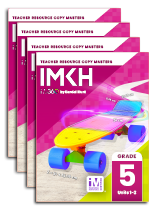
IM v.360: Grade 5 Teacher Resource Copy Master Set
IM® v.360 K-5 Math is an IM Certified curriculum providing trusted, highly rated materials to ensure students thrive in mathematics. Each Illustrative Mathematics lesson has four phases, from pre-unit practice modules to cool downs, focusing students’ attention on definitions, notations, and graphical conventions contributing to the development of real numbers.
Grade 5
The big ideas in grade 5 include: developing fluency with addition and subtraction of fractions, developing understanding of multiplication and division of fractio
product:
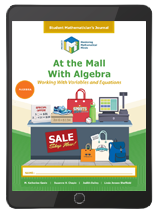
Project M3: Level 4-5: At the Mall With Algebra: Working With Variables and Equations Student Mathematician's Journal 1 Year License
The Student Mathematician’s Journal allows students to explore simulated or real-life problems and help them to think, write, and read like mathematicians. It encourages students to reflect on what they have learned in each lesson, think deeply about mathematics, and communicate in writing on worksheets.
In this unit, students represent and analyze mathematical situations using algebraic symbols, they come to understand the basic notions of equality and equivalent expressions through informal problem-solving. They learn how variables are used to represent