
Search Listing Name
product:
OpenSciEd Grade 1 Unit 3: Space Teacher Edition
The OpenSciEd elementary science program aligns with all NGSS standards for elementary education.
product:
OpenSciEd Unit 6.2: Thermal Energy Student Edition
OpenSciEd Middle School science program addresses all middle school NGSS standards. This comprehensive science curriculum empowers students to question, design, investigate, and solve the world around them.
- Phenomenon Based - Centered around exploring phenomena or solving problems
- Driven by Student Questions - Storyline based on students’ questions and ideas
- Grounded in Evidence - Incremental building and revision of ideas based on evidence
- Collaborative - class and teacher figure

product:
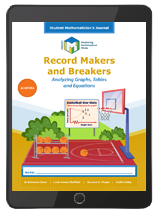
Project M3: Level 5-6: Record Makers and Breakers: Analyzing Graphs, Tables and Equations Student Mathematician's Journal 1 Year License
The Student Mathematician’s Journal allows students to explore simulated or real-life problems and help them to think, write, and read like mathematicians. It encourages students to reflect on what they have learned in each lesson, think deeply about mathematics, and communicate in writing on worksheets.
In this unit, students explore algebra as a system of concepts used to represent relationships. They learn to express these relationships using words, equations, tables, and graphs. By exploring world records, some of the most astonishing feats ever achie