
Search Listing Name

product:
IM: Grade 1 Bundle Center Kit - Spanish
To help educators save time, IM-aligned center kits provide all the printed resources to improve teaching efficiency and enhance student learning!
The Grade 1 Bundle Center Kit includes pre-cut game boards, recording sheets, and center & lessons card decks.
product:
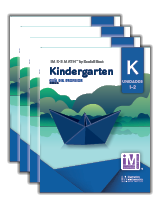
Illustrative Mathematics: Kindergarten Spanish Teacher Guide Set
Illustrative Mathematics K-5 MathTM is an IM Certified product providing trusted, highly rated materials to ensure students thrive in mathematics. Each Illustrative Mathematics lesson has four phases, from pre-unit practice modules to cool downs, focusing students’ attention on definitions, notations, and graphical conventions contributing to the development of real numbers.
The big ideas in kindergarten include: representing and comparing whole numbers, initially with sets of objects; understanding and applying addition and subtraction; and describing shapes
product:
Project M2 Level 1 Unit 1: Exploring Shape Games: Geometry with Imi & Zani Manipulative Kit
This kit includes:
- 3/4" counters, trans 6 color, set of 250
- 5/8" white dot dice, set of 8
- 20" diameter grouping circle, set of 6
- KH PM2 attribute shape label cards, set of 72
- KH PM2 attrib
product:
Navigator Heritage Series: Call of the Wild Study Guide 1 Year License
Jack London captures readers with vivid scenery, the complexity of feelings, and foreshowing in this harrowing tale of a mixed-breed dog named Buck who begins his journey in Southern California and through various circumstances finds himself in Alaska, the victim of the Klondike Gold Rush’s need for strong dogs to carry sleds across the frozen Klondike. Buck's journey from a life of domestication to a life that hearkens back to the primordial days of his breed is interwoven with brutality, perseverance, survival, affection, and devotion. During the journey, he encounters men who draw
product:
CryptoClub: Student Cipher Handbook
The Student Cipher Handbook is the centerpiece of the CryptoClub curriculum. It is a student reference and workbook that is recommended for use in informal learning environments such as after-school or enrichment programs. It introduces ciphers in a way that encourages problem-solving and reasoning, and provides engaging messages to encrypt, decrypt, and crack. The Student Cipher Handbook can be u