
Search Listing Name
product:
IM v.360: Grade 2 Lesson Only Card Deck Kit
To help educators save time, IM v.360-aligned center kits provide all the printed resources to imp
product:
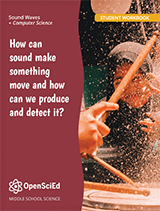
OpenSciEd Unit 8.2 + Computer Science: How can a sound make something move? Student Workbook
OpenSciEd Middle School science program addresses all middle school NGSS standards. This comprehensive science curriculum empowers students to question, design, investigate, and solve the world around them.
- Phenomenon Based - Centered around exploring phenomena or solving problems
- Driven by Student Questions - Storyline based on students’ questions and ideas
- Grounded in Evidence - Incremental buildi
product:
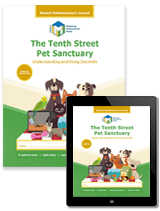
Project M3: Level 4-5: The Tenth Street Pet Sanctuary: Understanding and Using Decimals Student Mathematician's + Journal 1 Year License
The Student Mathematician’s Journal allows students to explore simulated or real-life problems and help them to think, write, and read like mathematicians. It encourages students to reflect on what they have learned in each lesson, think deeply about mathematics, and communicate in writing on worksheets.
Students are introduced to how the decimal numeration system takes place. Students learn how the powers of 10 are used to create decimals and understand the role of the decimal point as the marker for the end of whole num

product:
OpenSciEd Grade 2 Unit 3: Habitats Student Workbook
The OpenSciEd elementary science program aligns with all NGSS standards for elementary education. This comprehensive curriculum encourages students to explore, design, investigate, and solve problems in the world around them.
- Phenomenon Based - Centered around exploring phenomena or solving problems
- Driven by Student Questions - Storyline based on students’ questions and ideas
- Grounded in Evidence -
product:
IM: Grade 2 Bundle Center Kit - Spanish
To help educators save time, IM-aligned center kits provide all the printed resources to improve teaching efficiency and enhance student learning!
The Grade 2 Spanish Bundle Center Kit includes pre-cut game boards, recording sheets, and center & lessons card decks.
For a detailed list, please
product:
Project M2 Level K Unit 2: Exploring Shapes in Space: Geometry with the Frogonauts Student Mathematician Journal
The Student Mathematician’s Journal presents simulated or real-life problems that encourage students to think, write, and read like mathematicians. They are asked to reflect on what they have learned and communicate in writing on worksheets.
In this unit, students help prepare Fonzie Frog for his trip to the Lily Pad Space Station where he will join Freeda, a Frogonaut in space. Students are involve
product:
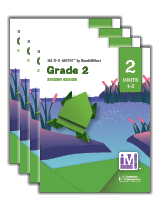
Illustrative Mathematics: Grade 2 Student Edition Set
Illustrative Mathematics K-5 MathTM is an IM Certified product providing trusted, highly rated Putting it All Together materials to ensure students thrive in mathematics. Each Illustrative Mathematics lesson has four phases, from pre-unit practice modules to cool downs, focusing students’ attention on definitions, notations, and graphical conventions contributing to the development of real numbers.
The big ideas in grade 2 include: extending understanding of the base-ten number system, building fluency with addition and subtraction, using standard units of mea