Search Listing Name

product:
OpenSciEd Grade 4 Unit 4: Structure & Function Non-Consumable Kit
This unit specific non-consumable kit includes items tha
product:
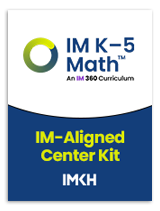
IM v.360: Grade 1 Center and Lesson Card Deck Kit
To help educators save time, IM v.360-aligned center kits provide all the printed resources to improve teaching efficiency and enhance student learning!
The Grade 1 center and lesson card deck kit includes center & lesson card decks only.
For a detailed list or information about bundle cen

product:
The Seven Kitties and the Feeling Tree
The Seven Kitties and the Feelings Tree is a heartwarming tale that teaches young readers -and the young at heart –about emotions, friendship, and the power of listening. One sunny day, seven kitty friends –Willie, Ayla, Skunk, Alto, Momo, Tempe, and Julius—gather under the Feelings Tree, a safe space where they can share their hearts and minds. They learn that every feeling, big or small, is important and that talking about them makes them stronger. Throug

product:
Project M2 Level 1 Unit 1: Exploring Shape Games: Geometry with Imi and Zani Student Mathematician Journal 1 Year License
The Student Mathematician’s Journal presents simulated or real-life problems that encourage students to think, write, and read like mathematicians. They are asked to reflect on what they have learned and communicate in writing on worksheets.
In this unit, students explore two-dimensional shapes and in doing so, discover properties of these shapes rather than memorize definitions given to them.
product:
Project M3: Level 4-5: Treasures from the Attic: Exploring Fractions Teacher 3 Year License
This unit provides an introduction to fractions, focusing on the meaning of mathematical operations in contextual situations rather than learning algorithms to perform computations. Students will learn the relative sizes of fractions and make estimates based on their mathematical thinking when ordering, comparing, adding, subtracting, multiplying or dividing two or more fractions.
The Teacher Guide<
product:
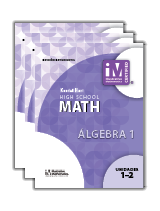
Illustrative Mathematics: Algebra I Spanish Student Edition Set
IM Algebra 1 is a problem-based core curricula rooted in content and practice standards to foster learning and achievement for all. Students learn by doing math, solving problems in mathematical and real-world contexts, and constructing arguments using precise language. Teachers can shift their instruction and facilitate student learning with high-leverage routines that guide them in understanding and making connections between concepts and procedures.