
Search Listing Name

product:
OpenSciEd Grade 4 Unit 3: Earth Processes Consumable Kit
Extend hands-on science learning in your classroom with aligned
product:
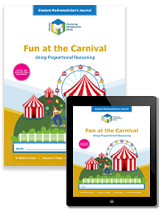
Project M3: Level 5-6: Fun at the Carnival: Using Proportional Reasoning Student Mathematicians Journal + 1 Year License
The Student Mathematician’s Journal allows students to explore simulated or real-life problems and help them to think, write, and read like mathematicians. It encourages students to reflect on what they have learned in each lesson, think deeply about mathematics, and communicate in writing on worksheets.
In this unit, students are introduced to ratios, rates, proportional reasoning, similarity and congruence. Students explore ratio as a comparison of two quantities. They discover that if the ratio between the corresponding side lengths and angle measures
product:
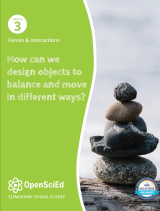
OpenSciEd Grade 3 Unit 1: Forces & Interactions Student Workbook
The OpenSciEd elementary science program aligns with all NGSS standards for elementary education. This comprehensive curriculum encourages students to explore, design, investigate, and solve problems in the world around them.
- Phenomenon Based - Centered around exploring phenomena or solving problems
- Driven by Student Questions - Storyline based on students’ questions and ideas
- Grounded in Evidence -
product:
Illustrative Mathematics: Grade 4 Spanish Teacher Resource Copy Master Set
Illustrative Mathematics K-5 MathTM is an IM Certified product providing trusted, highly rated materials to ensure students thrive in mathematics. Each Illustrative Mathematics lesson has four phases, from pre-unit practice modules to cool downs, focusing students’ attention on definitions, notations, and graphical conventions contributing to the development of real numbers.
The big ideas in
product:
IM v.360: Grade 3 Spanish Student Edition Set
IM® v.360 K-5 Math is an IM Certified curriculum providing trusted, highly rated materials to ensure students thrive in mathematics. Each Illustrative Mathematics lesson has four phases, from pre-unit practice modules to cool downs, focusing students’ attention on definitions, notations, and graphical conventions contributing to the development of real numbers.
Grade 3
The big ideas in grade 3 include: developing understanding of multiplication and division and strategies for multiplication and division within 100; developing unde
product:
Anchored Science Unit 6.4: Forces & Motion Student Workbook
Anchored Science by Mi-STAR is a comprehensive middle school science curriculum driven by a bold vision for the future, where science isn’t just a subject but a powerful, integrated body of knowledge that equips students to tackle today’s pressing societal challenges. This curriculum harnesses the full potential of the Next Generation Science Standards, empowering students to actively engage with science and engineering practices. They’ll move beyond the classroom, using their skills to solve