
Search Listing Name
product:
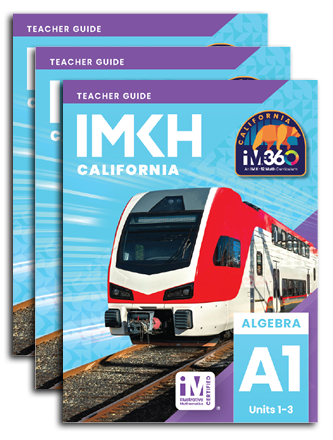
IMKH California: Algebra I Teacher Guide Set
IMKH California, an IM® v.360 math curriculum, is problem-based and builds strong classroom math communities. It gives students a clear progression of concepts and helps teachers deepen their understanding of math and student thinking.
The curriculum encourages collaboration and meaningful mathematical conversations, highlighting Big Ideas, Major Concepts, and Mathematical Practices, while integrating Environmental Principles & Concepts and supports for MLL, ELD, and EL students.
product:
Colors
2023 marked the ten year anniversary of my son Alex Araeipour’s passing. I decided to pay tribute to him by publishing his book Colors that he wrote and illustrated for a high school English class assignment. He suffered from a mental illness starting in ninth grade. He experienced and observed examples of acceptance and compassion over his lifetime along with experiences of intolerance and discrimination based on being “different” in appearance or personality etc. to those a
product:
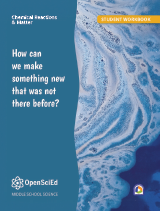
OpenSciEd Unit 7.1: Chemical Reactions (A) Student Workbook
OpenSciEd Middle School science program addresses all middle school NGSS standards. This comprehensive science curriculum empowers students to question, design, investigate, and solve the world around them.
- Phenomenon Based - Centered around exploring phenomena or solving problems
- Driven by Student Questions - Storyline based on students’ questions and ideas
- Grounded in Evidence - Incremental building and revision of ideas based on evidence
- Collaborative - class and teacher figure
product:
OpenSciEd Unit 8.1: Contact Forces Spanish Student Edition
OpenSciEd Middle School science program addresses all middle school NGSS standards. This comprehensive science curriculum empowers students to question, design, investigate, and solve the world around them.
- Phenomenon Based - Centered around exploring phenomena or solving problems
- Driven by Student Questions - Storyline based on students’ questions and ideas
- Grounded in Evidence - Incremental building and revision of ideas based on evidence
- Collaborative - class and teacher figure
product:
Worldly Words Student Literature Workbook 1 Year License
Have you ever wondered about the letters and words we use in talking and writing? What did people do before there were letters? Why are there only 26 letters in English? Often you are unaware that your questions drive your curiosity and exploration into language and communication. In this unit, your job is to decipher (figure out) the patterns, similarities, and differences of letters, word families and origins, sounds, and languages. Why are there so many languages in our world? Human language is unique and may help you to think in a different way as you explore the amazing variety o