
Search Listing Name
product:
More Than Just Words: Communication and Relationship Skills that Make a Difference
Communication is vital in every facet of our lives, and critical thinking about communication and social relations is an important developmental process. Children - like the rest of us - face daily challenges and with opportunities to become better communicators in their relations with family, friends, and acquaintances. More than Just Words is intended to encourage reflection, critical thinking, and the development of communication competencies at an early age. The book is written for young readers, and for pa

product:
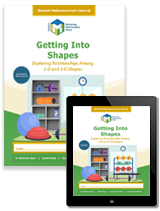
Project M3: Level 4-5: Getting Into Shapes: Exploring Relationships Among 2-D and 3-D Shapes Student Mathematician's Journal + 1 Year License
The Student Mathematician’s Journal allows students to explore simulated or real-life problems and help them to think, write, and read like mathematicians. It encourages students to reflect on what they have learned in each lesson, think deeply about mathematics, and communicate in writing on worksheets.
In this unit, students explore two- and three-dimensional shapes with a focus on their properties, relationships among them and spatial visualization. The reasoning skills that they build upon in this unit help them to develop an understanding of more com
product:
The Year of Miss Agnes Tradebook
This is a story of a gifted teacher and how she impacts her students and their community in post World War II Alaska. Fredrika (Fred), a young girl living in rural Alaska, narrates this story. Fred describes how life in Athabasca changes after a new teacher, Miss Agnes, comes to their school. Fred had experienced a series of teachers who did not understand the local culture and customs. Miss Agnes is different. She genuinely cares about the children as individuals and makes what they are learning relevant to their lives. Miss Agnes uses innovative teachin